Khasm Labs and Eridan are building a more open, resilient future for private 5G, combining KEEN OCUDU with innovative radio technology.

Every so often, the real value of an innovation ecosystem shows up long after a company graduates from the program that first brought everyone together. Eridan joined Khasm Labs as an alumni company with a fundamentally different approach to radio technology. Since then, we have continued developing technologies aimed at making advanced cellular networks more accessible, flexible and practical in environments where traditional approaches can create unnecessary complexity.
Last month we had the opportunity to demonstrate our collaboration supporting live use cases. At BlueTIDE 2026 in Newport, Rhode Island, Khasm Labs and Eridan brought those efforts together, helping pioneer the emerging OCUDU ecosystem through the demonstration of a KEEN Private 5G network incorporating Eridan's 2x2 Miracle® Radio Unit and, for the first time publicly, our new KEEN OCUDU platform.
Why OCUDU, and Why Now?
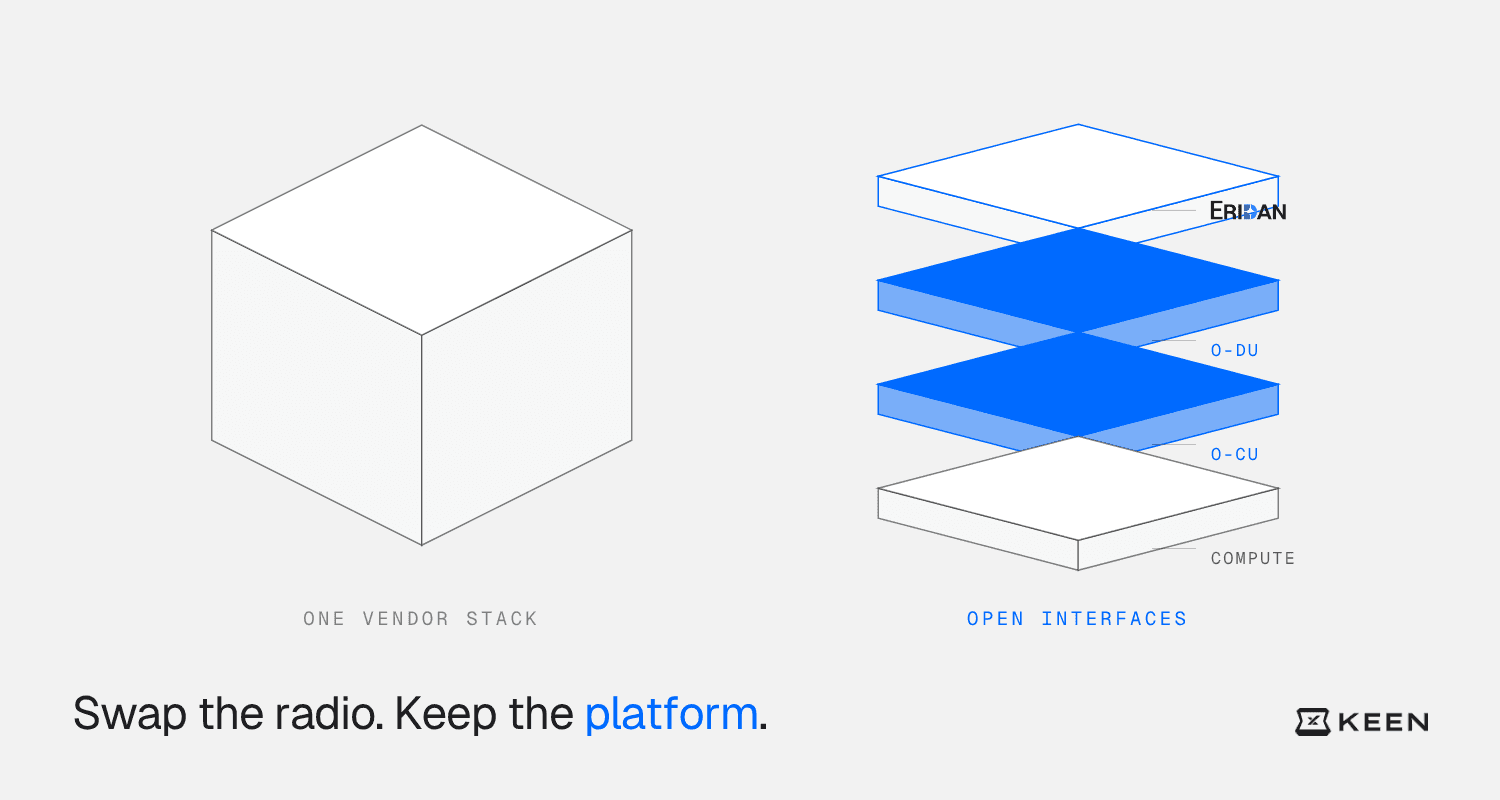
OCUDU didn't emerge in isolation. Its roots are connected to work within the U.S. Department of Defense and OUSD’s FutureG efforts to advance more open, interoperable, and software-driven approaches to next-generation wireless infrastructure. The underlying idea is consequential about disaggregating key elements of the Radio Access Network and establishes open interfaces between them so that innovation is no longer confined to a vertically integrated vendor stack. Instead, radio units, distributed units, centralized units, compute, and other network components can evolve independently while working together through standardized interfaces.
That matters because the environments where private 5G is increasingly being deployed don't all look the same. Defense, federal, industrial, and enterprise organizations may require different radios, spectrum bands, compute platforms, deployment models, and operational characteristics. A network architecture that dictates those choices can quickly become a constraint. KEEN OCUDU is our effort to bring this open and disaggregated philosophy deeper into the KEEN platform. By incorporating the O-CU and O-DU layers into KEEN, we're creating a foundation that can support a broader ecosystem of radio technologies while maintaining a common platform for deploying and operating the network. Much of Khasm's engineering in KEEN OCUDU sits above the open interfaces: an O-RAN M-Plane controller that provisions and supervises the radio unit, and a telemetry, correlation, and observability layer that ties DU, fronthaul, timing, and radio state into a single operational picture rather than a set of independent components.
Our work with Eridan demonstrates why that matters. Eridan focuses on fundamentally rethinking radio technology, while the open O-RAN M-Plane interface gives us the ability to integrate that innovation into the broader KEEN architecture. As the ecosystem grows, the same principle creates opportunities to support different radios and capabilities based on the requirements of the deployment rather than the limitations of a vertically integrated stack.
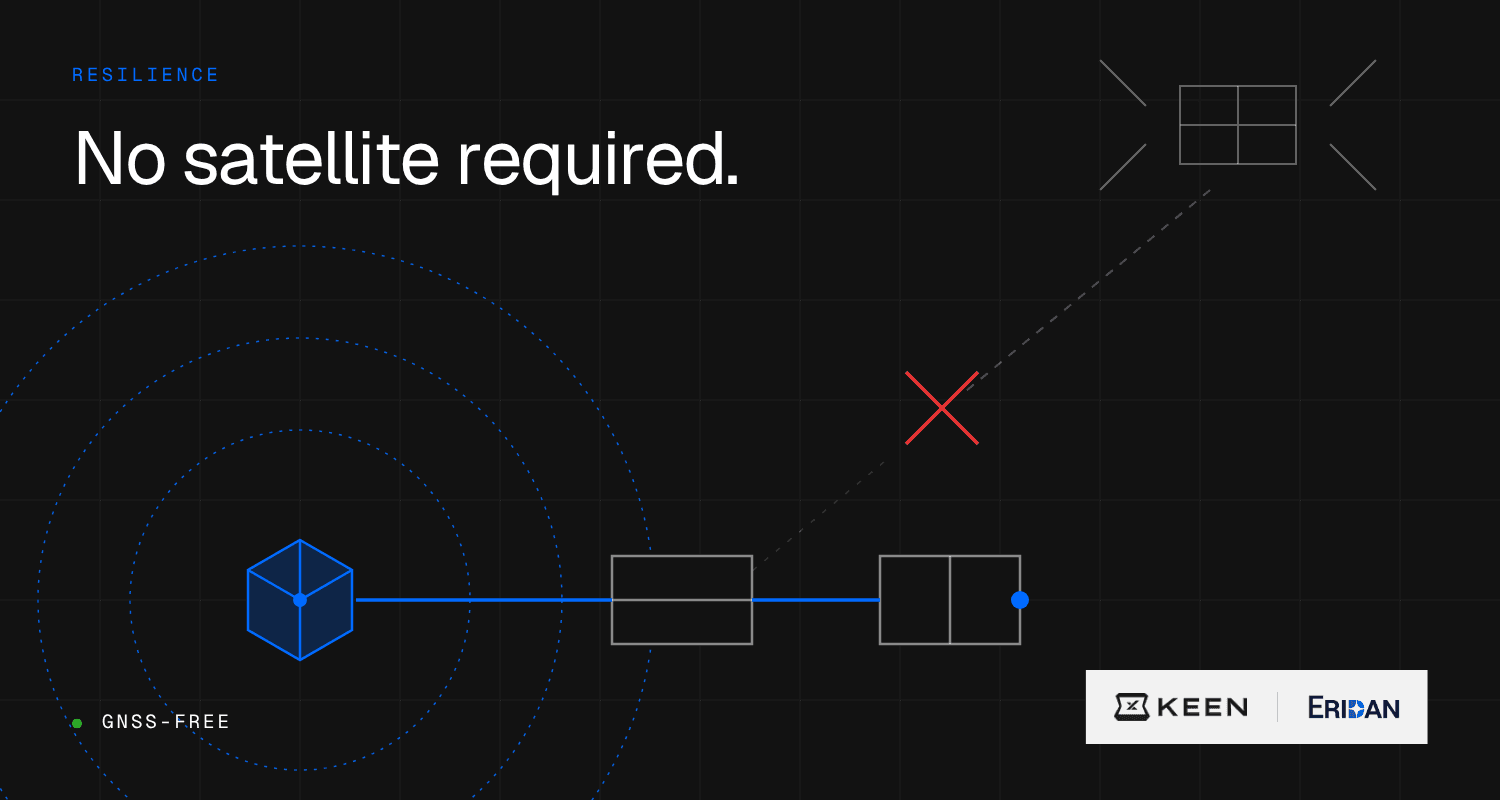
At BlueTIDE 2026, we also demonstrated another important dimension of that architecture: resilience. The combined KEEN OCUDU and Eridan platform operated throughout the event in GNSS-free mode, demonstrating the ability to maintain network operation without relying on GPS/GNSS as its timing source. That capability is particularly relevant in environments where satellite signals may be unavailable, degraded, denied, or jammed.
For us, the objective isn't openness for openness's sake. It's about creating choice at the radio layer, greater flexibility in how private 5G networks are assembled, and the ability to introduce new technology without rebuilding the network around every new radio. That's the ecosystem we're building around KEEN OCUDU.
A Different Kind of Radio
That makes our collaboration with Eridan particularly interesting. Eridan didn't simply build another conventional small-cell radio; they fundamentally challenged industry conventions for radio unit architectures. Instead of relying on the traditional power amplification approach used by most cellular radios, Eridan uses proprietary technology to generate its Ultra-Clean Signal™ while remaining remarkably energy efficient. The result is a compact radio designed for high performance and signal fidelity while consuming a fraction of the power required by conventional radio architectures. As RAN energy demands continue to grow, Eridan demonstrates that advancing radio performance doesn't necessarily have to come at the expense of power consumption — an increasingly important consideration across defense, federal, and commercial networks.
For Khasm, innovations like these demonstrate exactly why an open and interoperable ecosystem matters. The ability to bring differentiated radio technologies into a common architecture creates greater choice in how private 5G networks can be designed around the environments they need to serve.
Designed for Environments That Don't Cooperate
Open architecture is only valuable if the resulting network can operate where it is needed. Throughout the BlueTIDE event, the combined KEEN OCUDU and Eridan platform operated continuously in GNSS-free mode. That capability matters in environments where satellite-based positioning and timing may be unavailable, obstructed, degraded, denied, or intentionally jammed.
For private-sector deployments, GNSS independence can also simplify networks operating indoors or in locations where reliable satellite reception isn't practical. For federal and defense environments, the implications are even more significant. The result demonstrates another dimension of the architecture we're building: not simply an open and interoperable RAN, but a private cellular platform designed to remain operational without dependence on infrastructure that may not always be available.
Building the Ecosystem
KEEN has always been based on a relatively simple idea: private cellular should work more like enterprise infrastructure and less like a miniature telecommunications network. OCUDU extends that philosophy deeper into the RAN. Rather than defining KEEN around a single radio vendor or RAN implementation, we see an opportunity to build an ecosystem of interoperable technologies that can be assembled around the requirements of a particular environment. Eridan is an important part of that effort.
BlueTIDE gave our teams an opportunity to put that philosophy into operation. The event, hosted by Polaris Tech Bridge in collaboration with the U.S. Navy and Naval Undersea Warfare Center Division Newport, brings defense, industry and academia together around live maritime and dual-use technology demonstrations. For Khasm and Eridan, it provided exactly the kind of environment in which technologies like these should be evaluated: outside the lab, integrated with other systems and operating as part of a larger technology ecosystem.
And this is only the beginning. One of the reasons Khasm Labs exists is to bring emerging technology companies together with the organizations, infrastructure and opportunities necessary to turn innovation into deployment. Eridan's journey with us is a good example of what that can become. What began as an alumni relationship has evolved into a deeper technology collaboration. Together, we're exploring opportunities to bring the combination of KEEN, KEEN OCUDU and Eridan radio technology into additional U.S. Federal environments as well as private-sector deployments.
There is considerably more work ahead as we continue developing the KEEN OCUDU ecosystem, but the direction is clear. The future of private cellular shouldn't be defined by a single vendor's stack. It should be defined by the ability to bring together the best radios, software, compute, devices and applications for the problem being solved. At BlueTIDE 2026, Khasm Labs and Eridan took another step toward making that future real.
" width="154px"><path d="M 14.806 39.714 L 0 39.714 L 39.61 0 L 54.886 0 Z M 47.532 39.714 L 19.871 39.714 L 33.668 26.044 Z M 21.232 13.348 L 13.785 20.723 L 0.205 7.582 L 15.483 7.582 Z" fill="rgb(255, 255, 255)" height="39.71411411957996px" id="dP2jP6dlf" transform="translate(52.99 32.432)" width="54.88610485969207px"/><path d="M 146.102 12 L 130.308 56 L 154 100 L 136.231 120 L 17.769 120 L 0 100 L 23.692 56 L 7.9 12 L 21.719 0 L 132.281 0 Z M 33.565 56 L 19.744 92 L 134.256 92 L 120.435 56 L 130.308 18.001 L 23.692 18.001 Z" fill="rgb(255, 255, 255)" height="120px" id="dG_XZFrQ2" width="154px"/></g></svg>)
